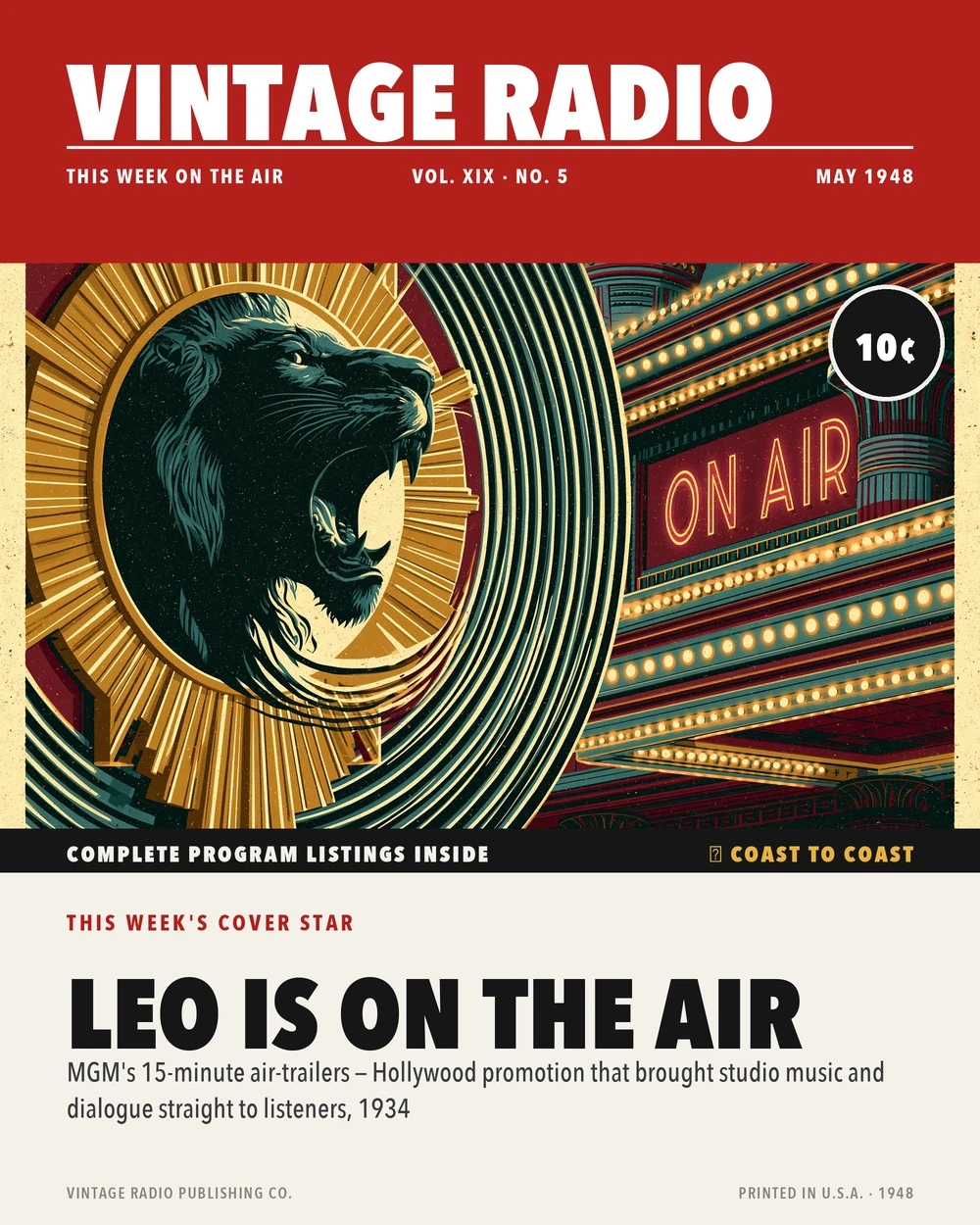
Leo Is on the Air
Radio Trailers Before Radio Trailers Were a Thing
Long before movie studios figured out how to reach audiences through television or the internet, MGM found a remarkably practical solution to the promotional problem: radio. Leo Is on the Air was the studio's series of short broadcast programs designed to pull listeners out of their living rooms and into theaters showing MGM pictures. Dating back as far as 1934, each episode ran just 15 minutes — tight, punchy, and engineered to do one job well. MGM called them "air trailers," which is exactly what they were: the radio equivalent of the "Coming Attractions" reel that played before the main feature.
What made the format smarter than a simple advertisement was what MGM actually put inside these programs. Announcers delivered enthusiastic synopses of upcoming or current releases, but the episodes didn't stop there. They wove in actual clips of dialogue and music pulled directly from the films being promoted. Listeners weren't just hearing a pitch — they were hearing the movie itself, condensed and framed for the ear. For audiences who had never seen a still from a given picture, that was a genuinely different kind of preview experience.
How the Air Trailers Worked
The distribution model was as clever as the programming itself. MGM pressed each episode as a one-sided 16-inch transcription disc spinning at 33⅓ RPM — at least some manufactured by RCA — and shipped them out to local radio stations across the country. Stations received them as "fillers": short programs they could slot in whenever they had open time in the broadcast schedule and needed to avoid dead air. That arrangement gave MGM essentially free promotional exposure while solving a real operational headache for stations. Everybody got something out of the deal.
The discs themselves carried specific legal language that reflected how carefully MGM managed the arrangement. A disclaimer printed on each one read: "For Sustaining Program Only — Not to be played on a sponsored program other than a program sponsored by a theatre in which Metro-Goldwyn-Mayer pictures appear." Alongside that, a blunt instruction: "Please destroy after use." The fact that so many survived anyway is a minor miracle of radio history, and the catalog today includes 91 episodes spanning releases from 1934 through at least 1945.
The opening of each episode recreated MGM's roaring lion logo and "Ars Gratia Artis" banner in audio form — the kind of production detail that made Leo Is on the Air feel like a real broadcast rather than a throwaway commercial. The show was named for that lion, the same one audiences saw at the beginning of every MGM picture.
What the Episodes Covered
The breadth of the catalog reflects MGM's output during one of Hollywood's most productive stretches. Episode titles in the collection include promotions for Merry Widow (1934), Mutiny on the Bounty (1935), Pigskin Parade and One in a Million (both 1936), Parnell, New Faces of 1937, and Mountain Music (1937), Man About Town (1939), Northwest Mounted Police and Marx Brothers Go West (both 1940), and Mr. Bugs Goes to Town (1941). Other MGM titles featured in the run include After the Thin Man, Libeled Lady, Life Begins for Andy Hardy, A Day at the Races, and The Wizard of Oz. Some episodes went beyond announcer narration and music clips to include appearances by cast members from the films being promoted — a step up from a straight synopsis.
The series continued producing episodes well past 1941. OTR catalog listings include an episode promoting The Bells of St. Mary's, which came out in 1945, suggesting the run extended at least to that point.
The Wizard of Oz Episode
Among the 91 episodes in the catalog, the one promoting The Wizard of Oz occupies a particular place in the record. When MGM assembled the air trailer for that film in 1939, the studio made the unusual decision to use the actual soundtrack versions of the film's songs rather than re-recorded or simplified alternatives. That meant listeners heard "Over the Rainbow" from the film itself, before the movie had opened. The radio preview reportedly helped push the song to the top of the hit parade charts ahead of the film's release — an early example of what later generations would call a media tie-in working exactly as intended.
That episode has also had a longer afterlife than most. It was preserved and included as a bonus feature on multiple home video releases of The Wizard of Oz, appearing on both DVD and Blu-ray editions, which makes it among the best-documented installments in the entire series.
Where Leo Fit in the Industry
MGM wasn't alone in producing this kind of program. Warner Bros., RKO, and Paramount all ran similar radio filler operations during the same era. Paramount's version was even called Paramount Is on the Air, a title that makes the competitive dynamic between studios fairly obvious. But MGM was one of the most prolific studios working in this format, and Leo Is on the Air was their primary vehicle for it.
There's also a technical footnote worth noting. For musical films, the air trailers sometimes drew on performances recorded during prerecording sessions — the studio work that happened before cameras rolled — rather than from the finished film's final soundtrack. That means some episodes in the series are, in practical terms, the earliest MGM soundtrack recordings ever put on disc for public distribution. The "please destroy after use" instruction on those discs makes their survival all the more unexpected.
A Piece of How Hollywood Used Radio
Leo Is on the Air sits at an interesting intersection of two industries that spent the 1930s and early 1940s figuring out their relationship to each other. Hollywood was wary of radio as a competitor for leisure time and entertainment dollars, but studios also recognized the medium's promotional reach. MGM's solution — produce short, music-and-dialogue-rich programs that served as both entertainment and advertisement — was a practical response to that tension, and it worked well enough that the studio kept the series running for more than a decade.
The 91 episodes in the catalog represent a slice of what MGM thought was worth promoting during that stretch, and the films they feature — from Marx Brothers comedies to epic productions like Mutiny on the Bounty — give the series an accidental quality as a kind of promotional archive of a particular Hollywood era. The lion roars. The announcer speaks. The music comes up. Then it's over in 15 minutes, and the listener knows a little more about what's playing downtown.